How the Commercial Solar Tax Credit Works in 2026
Ask most people about the solar tax credit and they'll tell you it expired. For homeowners, they're right — that credit ended in 2025. But if you own a business in Sarasota or Manatee County, the commercial version is a different animal entirely, and it remains one of the strongest tax plays in the building. It rests on two pieces working together: a federal credit and accelerated depreciation.
Piece one: a 30% federal credit
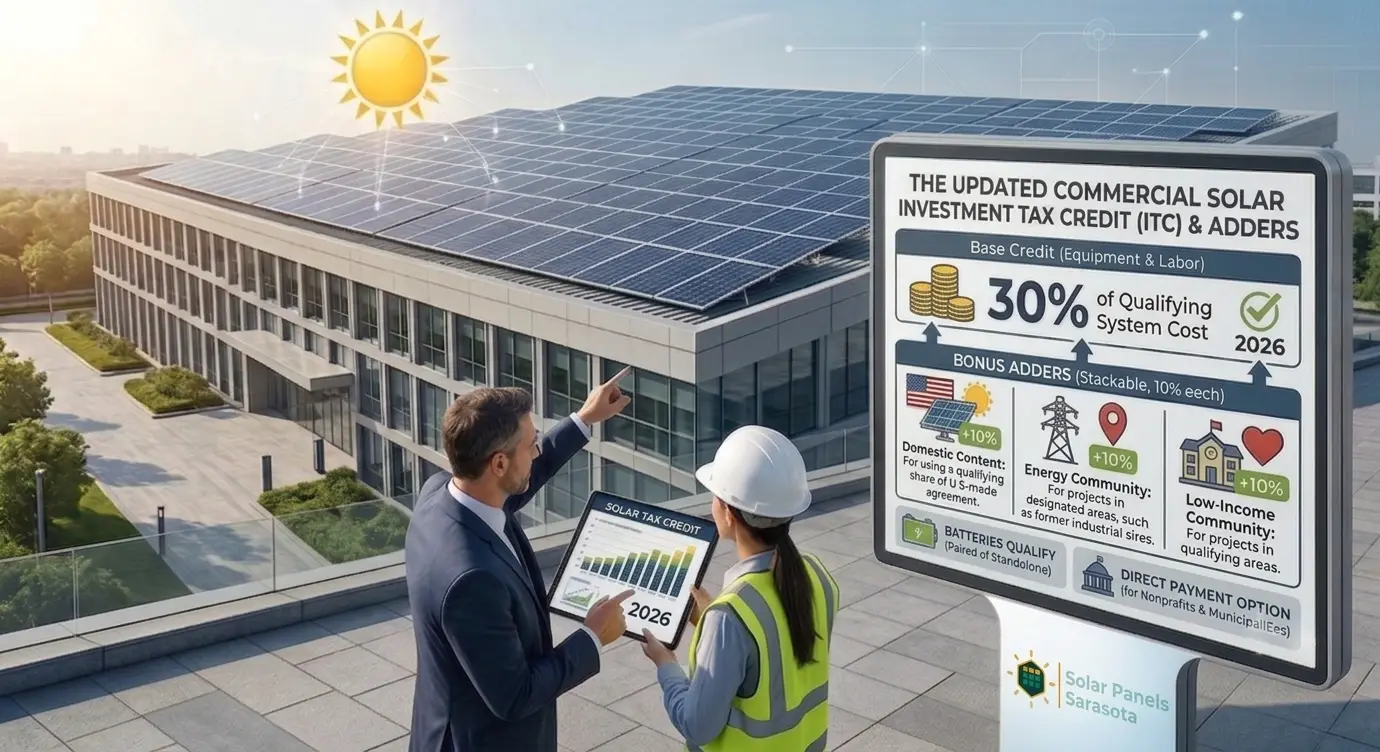
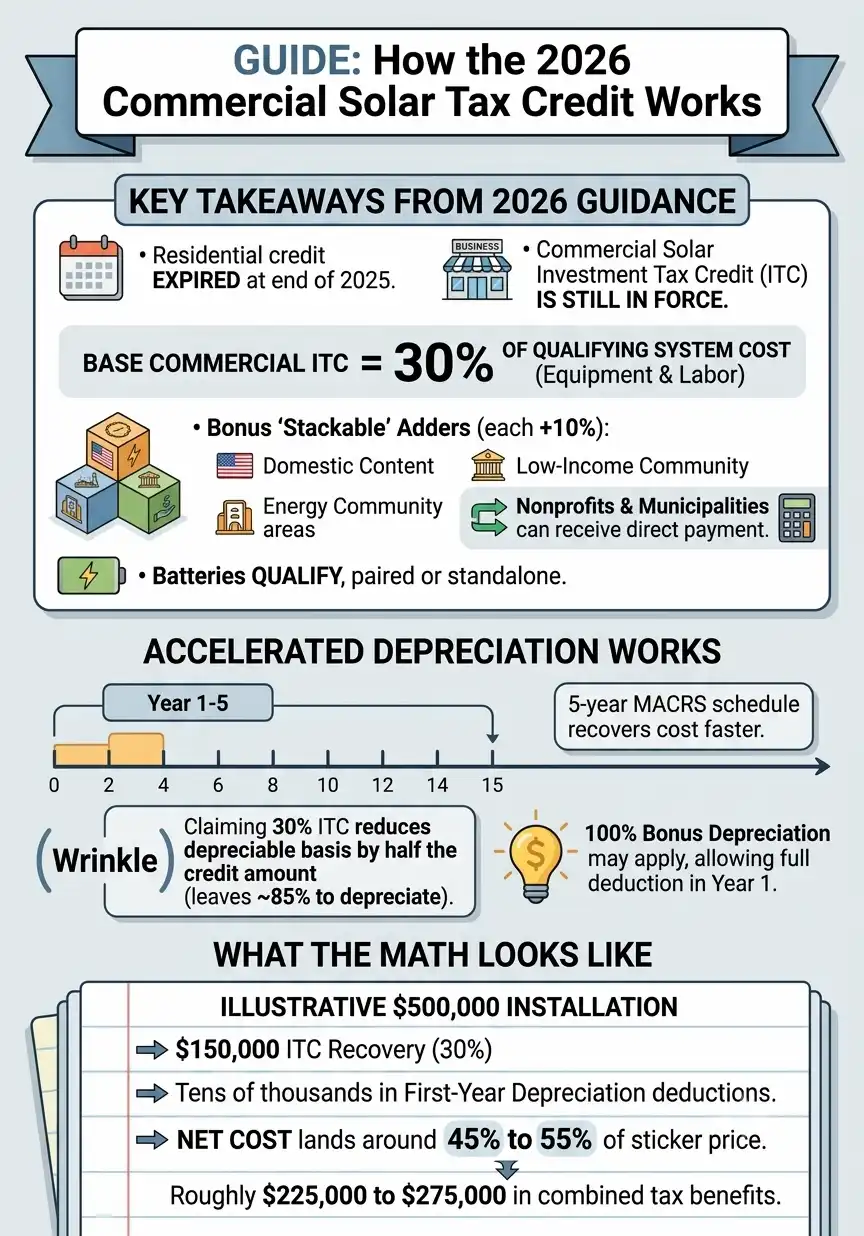
The commercial Investment Tax Credit (ITC) covers 30% of what a qualifying system costs — hardware and installation labor together. That 30% is the base. A set of bonus adders, each worth about 10% of the cost, can layer on top:
- Domestic content — a qualifying share of American-made equipment.
- Energy community — sites in designated industrial or former fossil-fuel areas.
- Low-income community — projects in qualifying areas.
Qualify for any of these and the credit runs well beyond 30%. Storage batteries are eligible too — paired with solar or standalone — and tax-exempt entities such as nonprofits and municipalities can now collect the credit as a direct payment instead of using it against taxes owed.
Piece two: five-year depreciation
The credit alone is compelling; combined with depreciation it's hard to beat. Solar counts as five-year MACRS property, so the cost is written down on an accelerated schedule that loads the deductions into the early years. One wrinkle: claiming the ITC reduces your depreciable basis by half the credit, which leaves about 85% of the system cost to depreciate. Layer on 100% bonus depreciation and the whole depreciable amount can come off in a single year.
The math on a sample system
Consider a $500,000 installation:
- The 30% ITC brings back around $150,000.
- First-year depreciation on what's left adds tens of thousands more in deductions.
- Together, the net cost frequently comes in near 45% to 55% of the sticker price — roughly $225,000 to $275,000 in combined tax benefits on that example.
Because so much rides on your specific tax situation, treat these as illustrative and confirm them with your accountant.
The deadlines you're working against
The credit comes with two qualifying paths: begin construction by July 4, 2026, or place the system in service by December 31, 2027. The construction date is behind us; the in-service date is the live one. Reach it and you keep the full 30%, the adders, and the depreciation.
"Placed in service" catches people out. It's not the contract date and not the delivery date — it's when the system is installed, inspected, and running, generally the moment FPL grants permission to operate.
Why late 2027 is really a 2026 start
Every commercial project moves through stages, and several hinge on outside parties:
- Engineering and structural review of the site.
- Permitting through Sarasota or Manatee County.
- Procurement, with genuine lead times on major equipment.
- FPL interconnection, where the queue can lengthen for bigger systems.
- Installation, inspection, and permission to operate.
Each runs weeks to months, and they only partly overlap. Count backward from a December 2027 finish and the comfortable start date is in 2026.
Whose business it suits
The economics favor businesses with real daytime power draw and space to host an array — roof, ground, or parking canopy. Across Sarasota and Manatee that's retail centers, hospitality, medical and professional offices, warehouses, and light manufacturing. The more tax capacity you have to use the credit and depreciation, the stronger the case.
How we deliver a commercial project
Solar is an electrical project first, and commercial work leaves little margin for error on load, structure, interconnection, and code. Every system is designed and installed in-house by our contractor, May Electric Solar, under licensed master-electrician oversight, and we own the full process — engineering, permitting, FPL interconnection, installation, and inspection. We'll model the after-tax return for your building and schedule it backward from the deadline.
The bottom line
For Sarasota and Manatee businesses, the pairing of a 30% federal credit, stackable adders, first-year depreciation, and steadily rising utility rates makes 2026 a strong time to evaluate commercial solar — and the 2027 window is tighter than it appears. Request a free commercial assessment and we'll build the numbers around your property, or visit our commercial solar page.
This article is general information, not tax, accounting, or legal advice. Federal incentives, bonus adders, and deadlines are complex and subject to change, and depreciation depends on your business's situation. Consult a qualified tax professional before making decisions based on current incentives.